

Last reviewed: 13 October 2026
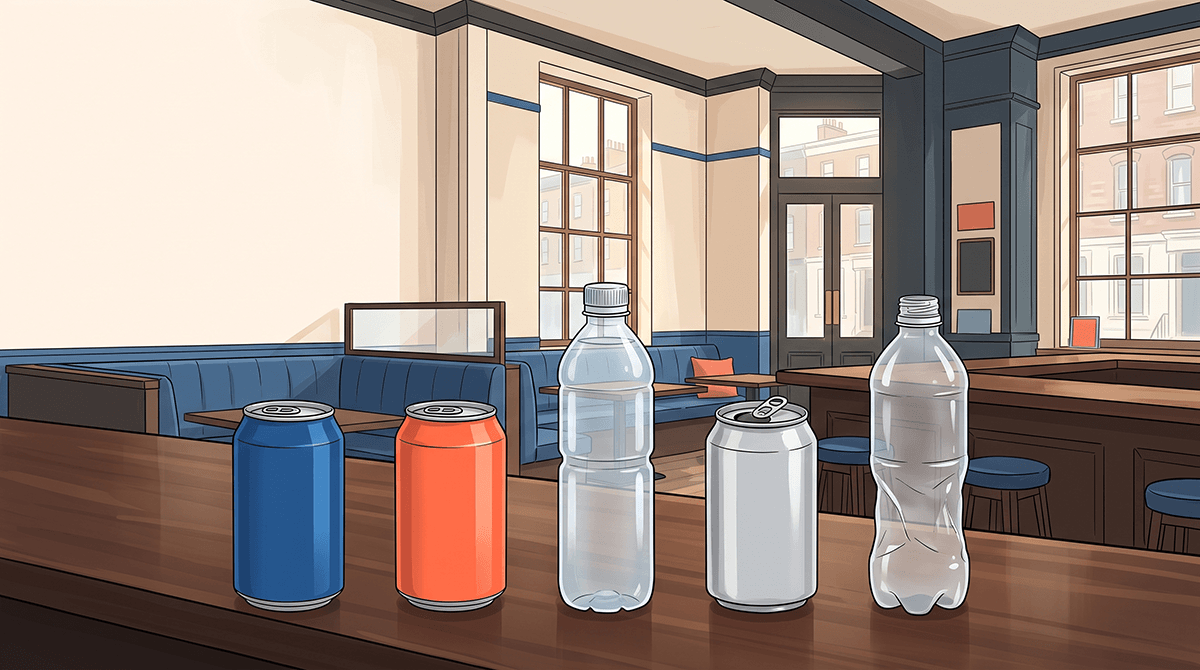
Picture two customers ordering the same bottled drink from a London restaurant. One opens it at the table; the other takes it away. Under the Deposit Return Scheme (DRS), that difference will matter.
The scheme is due to launch on 1 October 2027 in England, Northern Ireland and Scotland. It will add a refundable 20p deposit to eligible drinks containers, with different rules for drinks consumed on the premises and those sold to take away. Wales also plans to launch its scheme in October 2027, but its inclusion of glass creates an important national difference.
For a pub, bar or restaurant, the practical questions are straightforward: which products are covered, when should the customer pay the deposit, what happens to empty containers and does the venue need to accept public returns? This guide explains the current position, with London and England as its main focus.
What starts on 1 October 2027?
DRS is designed to increase recycling, reduce litter and improve the quality of recovered material.
In England, Northern Ireland and Scotland, the core scheme will cover single-use drinks containers made wholly or mainly from PET plastic, aluminium or steel, holding 150ml to 3 litres inclusive. Material, size and whether the container is single use all matter; the type of drink alone does not decide eligibility. Our guide to which drinks containers will carry a DRS deposit explains the detail.
Exchange for Change, the scheme administrator, confirmed in April 2026 that the deposit will be 20p for each in-scope PET, steel or aluminium container in the England, Northern Ireland and Scotland scheme.
The 20p is attached to the container and is separate from the underlying drink price. Returning an accepted container provides a route to recover that value; it does not make the drink itself cheaper or free.
What will change for a pub, bar or restaurant in England?
A venue buying affected stock will normally pay the deposit to its supplier. What happens next depends on how it sells the drink.
For a drink supplied for immediate consumption on the premises in England, the venue may choose not to charge the customer the deposit. If it uses that option, the current regulations require clear, accessible information where customers choose the items. The notice must explain that the venue is not required to charge the deposit for immediate on-site consumption and ask customers not to remove the empty containers.
Keeping those empties matters because the venue has already paid deposits upstream. Recovery will depend on accepted containers entering an appropriate return or collection route. Precise hospitality procedures still need to be confirmed, so venues should not assume that every purchased container will produce an automatic credit.
For a takeaway or other off-premises sale, the customer must be charged the deposit. A pub serving some drinks at tables and others to take away will therefore need to distinguish the two routes. Our guide to deposits, takeaway sales and empty containers follows the transaction from purchase to return.
Serving drinks does not automatically make you a public return point
An ordinary pub, bar or restaurant in England is not required to accept bottles and cans brought in by the public merely because it sells drinks. Under the current rules, the mandatory return-point duty applies to defined groceries retailers, while hospitality venues such as bars, restaurants and clubs selling food and drink for consumption on the premises are excluded from that definition.
A venue can seek authorisation to run a voluntary return point, but that is a separate role. Retaining containers emptied on site is different from accepting containers bought elsewhere.
Mixed businesses should look at their actual activities. A venue with a grocery-retail operation may need to check whether the statutory definition applies to that part of the business.
The four-nation position at a glance
The schemes are coordinated in several respects, but the hospitality rules are not identical across the UK.
| Nation | Current position relevant to hospitality |
|---|---|
| England | Launch is due on 1 October 2027. Eligible single-use PET, aluminium and steel containers from 150ml to 3 litres carry a 20p deposit. A venue may choose not to charge it for immediate on-site consumption, subject to the information requirement; takeaway sales carry the deposit. |
| Northern Ireland | The principal regulations and the broad on-site/takeaway approach are shared with England. Venues should still check the latest national guidance before launch. |
| Scotland | Launch is due on 1 October 2027 with the same core materials, size range and 20p deposit. Under current Scottish guidance, a drink definitely consumed on the premises should not attract the customer deposit; the venue retains the container for collection by Exchange for Change. Takeaway sales carry the deposit. SEPA explains the current Scottish business rules. |
| Wales | The scheme is planned for October 2027 and includes PET, aluminium, steel and glass. Glass is included from launch but will carry a 0p deposit and need no DRS-specific label during a four-year transition; a deposit is not due to apply to glass until October 2031. The Welsh Government sets out this transition. Detailed Welsh hospitality arrangements need a separate current check. |
For a London venue, the England rules are the working basis. Cross-border groups will need to account for the national differences.
DRS, packaging EPR and Simpler Recycling cover different jobs
Several packaging and waste changes can appear on the same planning list, but they are separate regimes.
- DRS adds a refundable deposit and return route to eligible drinks containers.
- Packaging extended producer responsibility (EPR) concerns the packaging responsibilities of organisations that meet the relevant activity and threshold tests.
- Simpler Recycling sets workplace waste-separation requirements in England. It already applies to most workplaces, while micro-firms have until 31 March 2027.
DRS does not remove a venue’s other packaging or workplace-waste responsibilities. Our guide to packaging EPR and Simpler Recycling explains those obligations separately.
Three questions to ask next
Venues can make a useful start before final collection details are settled.
- Which formats are likely to be affected? Check material, capacity and whether each container is single use. The hospitality stock guide explains why a can, PET bottle and glass bottle may receive different treatment.
- Which sales are on site, and which are takeaway? Map service routes where the place of consumption may differ. The guide to deposits, takeaway sales and empty containers explains why this matters.
- What can we prepare now, and what must we confirm later? Consider stock information, sales routes and space for empties, while leaving collection specifications and reimbursement timing open. The venue preparation guide separates early work from later checks.
Because the scheme is still developing, venues should check the latest national regulations and Exchange for Change guidance before making final operational decisions.
Frequently asked questions
When does DRS start for pubs and restaurants in England?
The main provisions are due to commence on 1 October 2027. This article reflects the pre-launch position on 13 October 2026 and should be checked again as launch approaches.
Is the deposit definitely 20p?
Yes. Exchange for Change confirmed a flat 20p refundable deposit in April 2026 for in-scope PET, aluminium and steel containers in England, Northern Ireland and Scotland. It is separate from the underlying drink price.
Does my pub have to accept bottles and cans from the public?
An ordinary hospitality venue in England is not automatically a public return point. The mandatory duty applies to defined groceries retailers. Mixed businesses should assess their actual retail activities; venues may seek authorisation to operate a voluntary return point.
Are glass bottles included?
Not in the England, Northern Ireland and Scotland scheme. Wales includes glass from launch, but it will have a 0p deposit and no DRS-specific labelling during the four-year transition to October 2031.
Start with your stock and sales routes
Review the packaged drinks you buy and where each is normally consumed. If you buy through Champers, discuss affected stock and the product information and supplier communications you will need as launch approaches. Identify the accounting and system questions now, but wait for confirmed collection, acceptance and reimbursement guidance before committing to final workflows.



 Group


