

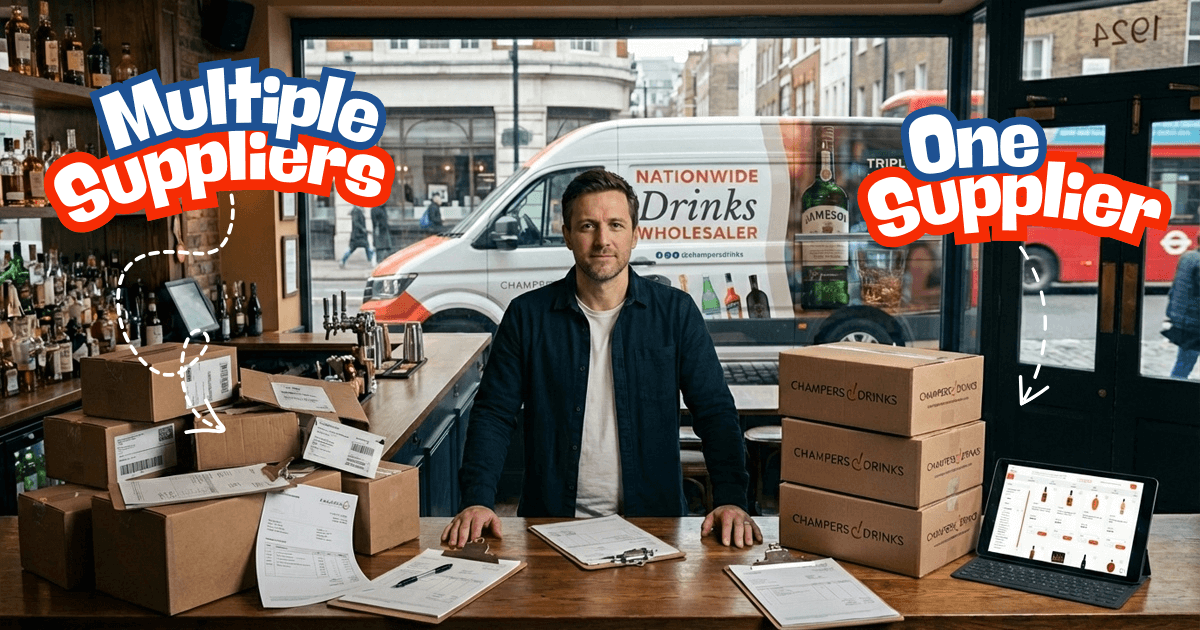
Running a venue means making hundreds of small decisions every week. Some feel minor, like where you buy your soft drinks or who supplies your house wine. Others feel bigger, like changing your menu or hiring a new manager. But one decision quietly shapes your daily operations more than most owners realise: how you structure your suppliers.
Many venues end up with a mix of suppliers simply because it happened over time. A recommendation here, a better price there, a new brand rep who seemed helpful. Before long, you are dealing with four or five different companies, different delivery days, different invoices, and different rules.
This article is not about chasing the cheapest case of beer. It is about helping you decide which supplier model gives you the most control, the least friction, and the clearest way to run your business.
Why Supplier Structure Is an Operational Decision, Not a Pricing One
Most owners think about suppliers in terms of price. How much does this bottle cost compared to that one. Who offers the best deal this month. Those questions matter, but they are only part of the picture.
Your supplier structure affects how your venue actually runs. It shapes how often things go wrong, how easy it is to fix problems, how much time your team spends ordering, and how predictable your stock levels are. It even affects your stress levels.
When you choose a supplier model, you are designing a system. That system can either make your life easier or quietly create friction every single week. Many venues focus on unit price while ignoring the operational load they are taking on.
What Do We Mean by One Supplier vs Multiple Suppliers?
Before comparing the two, it helps to be clear about what each model really looks like in practice.
The One-Supplier Model
This means having one main wholesaler that supplies most or all of your drinks categories. Beer, wine, spirits, softs, mixers, and sometimes snacks or bar essentials all come from the same place.
Venues choose this model because it feels simple. One login, one order process, one delivery window, and one main point of contact. When something goes wrong, you know exactly who to call.
This does not mean you can never use a specialist. It just means your core operation runs through one main supplier.
The Multiple-Supplier Model
This model uses different suppliers for different needs. You might buy wine from a specialist merchant, craft beer from a local brewery, spirits from a niche importer, and soft drinks from a cash and carry.
Venues choose this model to access niche products, build a stronger story around their drinks, or feel more flexible. It can be great for concept-led venues, but it also adds layers of complexity.
Control: Which Model Gives You More of It?
Control is not about micromanaging. It is about predictability. Knowing what will arrive, when it will arrive, and what will happen if something is missing.
With multiple suppliers, control can become fragmented. Each supplier has their own systems, their own delivery days, and their own policies. When something goes wrong, responsibility can feel blurred. One might blame the courier, another might blame the warehouse, and you are left chasing answers.
With one main supplier, control tends to be clearer. There is one system, one relationship, and one place where accountability sits. That does not mean mistakes never happen, but it often means they are easier to resolve.
Control also affects planning. When your stock data, lead times, and availability are spread across several platforms, forecasting becomes harder. When everything sits in one place, it becomes easier to see patterns and anticipate needs.
Simplicity: The Hidden Profit Multiplier
Simplicity is not lazy. It is strategic.
Every extra supplier adds admin.
- More invoices.
- More statements.
- More payment dates.
- More logins.
- More ordering rules.
- More people to train.
These tasks might feel small, but they add up. They take time from you or your managers. They increase the chance of mistakes. They slow down decisions.
Simplicity also reduces mental load. When your team knows where everything comes from and how to order it, they move faster. When you can glance at one system and understand your stock position, you make better choices.
Many owners underestimate how much money is lost through friction rather than price. Late orders, emergency runs, missing items, and duplicated stock all have a cost, even if it does not show clearly on a spreadsheet.
When Multiple Suppliers Actually Make Sense
Multiple suppliers are not a bad idea. They just need to be intentional.
If your venue is built around a strong drinks identity, specialists can add real value. A wine-led restaurant benefits from a merchant who understands terroir, producers, and food pairings. A craft beer bar may need direct relationships with independent breweries. A cocktail bar might rely on niche spirits that large wholesalers do not carry.
In these cases, the product itself is part of the experience. Guests come for it. It justifies the extra complexity.
However, even in these setups, structure matters. Each supplier should have a clear role. Overlap creates confusion. Too many exceptions create chaos.
If you go down this route, documentation becomes important. Delivery days, order cutoffs, minimum spends, and backup plans should all be written down and shared with your team.
When One Supplier Usually Wins
For most high-volume, fast-paced venues, one main supplier tends to work better.
If your menu changes often, if your team is busy, if you have limited admin capacity, or if consistency matters more than niche depth, simplicity usually wins.
One supplier reduces variables. Fewer things can go wrong. When something does go wrong, it is easier to fix.
This model also supports growth. If you open another site or extend your hours, your systems can scale more easily. You are not multiplying complexity every time you expand.
Owners who want clarity and calm often find that consolidation helps more than they expect.
The Real Trade-Offs Most Owners Do Not See
Every model has trade-offs. The problem is that many of them are invisible at first.
Multiple suppliers offer choice, but choice requires time. It requires comparison, coordination, and decision-making. That is work.
One supplier offers simplicity, but it might mean fewer niche options. You trade depth for ease.
Price differences can feel important, but they rarely tell the whole story. Saving a small amount per case can be wiped out by one missed delivery or one staff member spending an hour fixing an order issue.
Most of these costs do not show up neatly. They appear as stress, delays, rushed decisions, and constant firefighting.
How to Choose the Right Model for Your Venue
Instead of copying what other venues do, step back and ask a few honest questions.
How complex is your menu? How often do you change products? How much time do you personally spend dealing with supplier issues? How predictable is your demand? How important is product depth compared to speed and reliability?
If you are constantly chasing deliveries, managing shortages, or correcting mistakes, your structure might be the problem, not the people.
If you feel overwhelmed by admin or disconnected from your stock, that is another sign.
Choosing the right model is not about being right. It is about being intentional.
Designing Your Supplier Setup, Not Drifting Into It
Most venues drift into their supplier structure. One decision leads to another. Over time, the system becomes messy.
Designing your setup means thinking of it as a system. What is the main flow of goods? Who is responsible for what? What happens when something is out of stock?
It also means reviewing it regularly. What worked when you opened might not work now. Growth, menu changes, and staffing changes all affect what you need.
Writing things down helps. Delivery schedules, escalation processes, and ordering rules should not live only in someone’s head.
Where a Wholesaler Like Champers Fits In
A wholesaler like Champers is designed to support the one-supplier model.
The value is not just in the products. It is in the structure.
- A broad range means fewer separate orders.
- Consolidated deliveries mean fewer disruptions.
- A single account manager means clearer communication.
This kind of setup reduces operational noise. It gives owners and managers more headspace to focus on guests, staff, and growth.
It is not about limiting choice. It is about making choice easier to manage.

Let’s bring it all together:
Choosing between one supplier and multiple suppliers is not a moral decision. It is a design decision.
Both models can work. The question is which one works for your venue, your team, and your goals.
If your current setup feels heavy, chaotic, or fragile, it might not be a people problem. It might be a structure problem.
Step back. Look at how your system really operates. Ask yourself if it is helping you run your venue or quietly slowing you down.
The best supplier setup is the one that gives you control, clarity, and calm.
And that is worth far more than a small saving on a single product.





 Group
Group

